Welcome to the first issue of Roseman Dental’s Dental 360° monthly e-newsletter. Each month you’ll receive a panoramic view of dental health. Dental health is key to your overall health and here at Roseman Dental, we are dedicated to improving not only your mouth, but your whole self. At our clinic we have an excellent team of licensed dentists, orthodontists, orthodontic residents – 30 to be exact, and dental residents all focused on you and your family’s oral health. Roseman Dental has been serving its community since 2009 and is a one stop shop for all your dental needs.
This month is National Children’s Dental Health Month (NCDHM), a month-long national health observance started by the American Dental Association (ADA) that is dedicated to promoting the benefits of good oral health to children, their caregivers, teachers and many others. This year’s NCDHM theme is “Water, Nature’s Drink” because this year marks 75 years of water fluoridation.
Water Fluoridation
Water Fluoridation is the addition of fluoride to drinking water to increase the natural fluoride level up to the recommended level that helps prevent cavities. Almost 75 percent of the U.S. population is served by fluoridated community water systems as of 2012. According to the ADA, more than 70 years of research has consistently shown that an optimal level of fluoride in community water is safe and effective and it prevents tooth decay by at least 25% in both children and adults. Fluoride fights cavities by assisting in rebuilding (remineralizing) weakened tooth enamel and reverses early signs of tooth decay. Did you know that tooth decay remains one of the most common diseases in children? According to the Centers for Disease Control and Prevention (CDC) more than 25% of 2- to 5-year-olds have one or more cavities, half of kids 12- to 15-years old have one or more cavities and tooth decay affects two thirds of 16- to 19-year-olds. If you and your family drink tap water, bottled water with fluoride or use fluoride toothpaste, you are helping to prevent cavities. That’s simple to do, right?
There is some controversy over water fluoridation, but the ADA, the United States Public Health Service (USPHS), the American Academy of Pediatrics (AAP), and the World Health Organization (WHO), among many other national and international organizations, endorse community water fluoridation. In addition, the CDC recognized fluoridation of water as one of the 10 greatest public health achievements of the 20th century.
Too Much Fluoride?
Fluoride is safe and effective when used properly and in the correct doses. It is possible to get too much fluoride; however, typically children are the ones affected when they are exposed to excessive fluoride for an extended period when they are young. This is called dental fluorosis. Because water fluoridation is monitored in the United States, children can get dental fluorosis when they swallow too much fluoride toothpaste. To prevent this from happening, make sure to watch your children when they brush their teeth to ensure that they are spitting the toothpaste out instead of swallowing it.
As we make our way through February, work on teaching your children the importance of having good oral health. This month’s issue of Dental 360° has articles that can assist you with making oral health fun for your family. If you’re looking for some fun activities centered around NCDHM, download the ADA’s set of activity sheets below.
Roseman Dental is pleased to offer new and existing patients a voucher for dental care. The voucher can be used towards the cost of a comprehensive or periodic exam and necessary radiographs up to $119.00, and an additional $100.00 for needed dental care, for a total value up to $229.
The offer has been extended from Monday, February 7, 2022, through Monday, March 31, 2022. At Roseman Dental, your health is our #1 priority.
Oral health is central to your overall health. Oral health includes your teeth, mouth and surrounding craniofacial structures (skull & face). Having good oral health assists in improving your ability to speak, smile, smell, taste, touch, chew, swallow, and make facial expressions to show feelings and emotions.
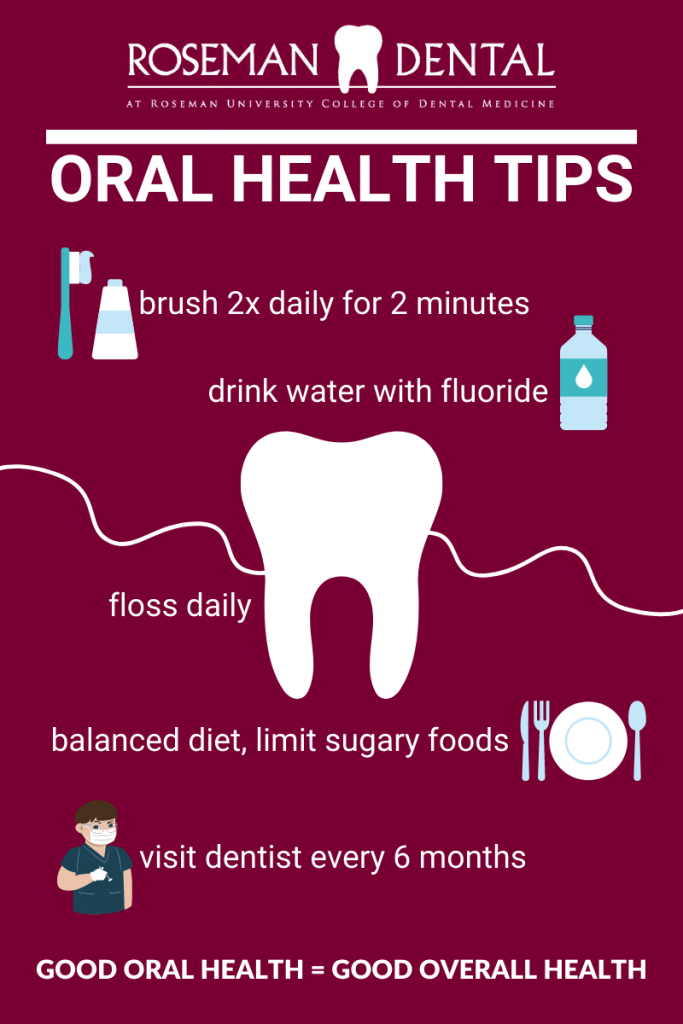
To keep up on your oral health you should be
Brushing your teeth twice a day for two minutes with fluoride toothpaste
Drinking water with fluoride
Flossing daily
Eating a balanced diet
Limiting sweet snacks between meals
Staying away from sugary foods and drinks and try not to sip or eat on them all day. If you want a sugary food or drink, have one at mealtimes.
Visiting your dentist regularly
If good oral health is not maintained, you are at risk of things such as cavities and periodontal disease, both of which can impact your overall health.
Barriers to Good Oral Health
Limited access to and availability of dental services
Lack of awareness of the need for care
Cost
Fear of the dentist/dental procedures
With the voucher*, Roseman Dental hopes to eliminate the cost barrier for you and your family. Let’s make 2022 a year dedicated to our oral and overall health.
Often times, parents wonder when they should start taking their child to the dentist. It is in fact sooner than you may think! You cannot be too early to start your child with their oral hygiene care routine. The American Association of Pediatric Dentists recommends that parents establish a dental home for their child by the time the first tooth erupts or by their first birthday. The dentist can examine your child’s teeth and ensure there are no concerns early on.
Why are Baby Teeth Important if They’re Just Going to Fall Out?
Indeed, the baby teeth or primary teeth are going to be lost. Parents ask, “So then why is it so important to take my 1 year old to the dentist?” Baby teeth are so important because they are replaced by permanent teeth. This is why it is crucial to maintain the health of the baby teeth so they are able to save space for the teeth replacing them. Poor oral hygiene such as not brushing or not using fluoridated toothpaste sufficiently can lead to decay in teeth which can potentially give rise to infections or even spread to new adult teeth which are erupting just below.
A common oral health risk for infants is the baby bottle. When your child consumes sugary liquid, the bacteria in their mouth start to flourish and cause decay which can break down their teeth. To avoid this, as a safer option you may give them a bottle of water before they sleep or you may use a wet washcloth to wipe their gums and teeth if they must absolutely have milk at night.
Oral Health Tips You Need to Know
We recommend the following tips to ensure that your child is on their way to a healthy mouth and healthy life:
Visit the dentist routinely at least every 6 months
Use about a grain size of fluoridated toothpaste for baby teeth as teeth start to erupt. For kids ages 2-6, you can use a pea-sized amount of fluoridated toothpaste and ensure that they are not swallowing it
Lay your child down facing away from you with their head between your legs and begin flossing as early as their teeth begin to touch
Use a damp washcloth to wipe teeth and gums after any food or drink for infants
Avoid an excess of sugary drinks or snacks between meals because this can increase the chances of cavities forming
Keep them hydrated – water not only helps to rinse away sugars that can cause cavities, but also provides a natural source of fluoride for their teeth!
Tiny teeth are just as important as big teeth. Contact Roseman Dental today if your little one is in need of a dentist.
Tanisha Khurana DMD Candidate Class of 2023
Roseman University College of Dental Medicine
ASDA Chapter Fundraising Chair
Pediatric Club Outreach Coordinator
Good habits are easiest taught at a young age. Oral health plays an intricate part in your child’s overall health, so of all habits to start young, good oral health habits should be at the top of the list. Poor oral health causes kids to miss over 51 million hours of class each year. February is National Children’s Dental Health Month and Gum Disease Awareness Month, so it’s a perfect opportunity to start teaching your children about the importance of good oral health. Good oral health is also critical in building positive self-image and confidence within children. We understand that trying to teach your child any habit can be difficult, but if you make oral health fun it can make creating those habits a lot easier. Here are some helpful tips to help start oral health habits with your children.
Toothbrush & Toothpaste
It’s important to let your children help choose their own toothbrush and toothpaste. When you’re at the store or ordering online let them pick the toothbrush that is their favorite color or the one that has their favorite Disney character. Also let them pick a toothpaste that is their favorite flavor. If they pick their toothbrush and toothpaste, they are more likely to want to brush their teeth every morning and night
Family Time
Make oral health habits a family affair, brush and floss your teeth together. Kids are known to copy what their parents do, so if you have a positive attitude about oral health and brush and floss your teeth with proper technique, your children are likely to mimic you.
Books
There are a lot of good books out there that teach about oral health and the dentist. Stories designed for children are great for teaching them how to take care of their teeth and for making oral health something that they can relate to. Here are few good ones that are fun to read with your children before bedtime.
When it’s time for your children to brush their teeth, you can start a sand timer or regular timer or even better, play their favorite song that runs for two minutes. Playing their favorite song or one they really like helps keep them focused on the song, not the two minutes that they need to be brushing their teeth.
Videos
There are a lot of good YouTube videos out there that you can watch with your children that teach about oral health. Here is a fun video by the Native American ToothFairy.
Post Dental Visit
After your children visit the dentist, it’s okay to reward them for their hard work and for their good oral health. It’s important to note that it’s not good to reward them with sugary food that can damage their teeth. Instead offer your children something healthy or a toy. Or even better, take them to do a fun activity. Maybe visit their favorite park or watch their favorite movie when you get home.
Don’t Give Up
It’s important to keep practicing oral health habits with your children even though it can be a challenge. If you can get your children excited about daily dental hygiene, they will be able to create a habit that will stay with them as they get older. We know the topic of oral health isn’t that intriguing to children, but you can make it fun so that they don’t dread brushing and flossing their teeth or visiting the dentist.
Roseman Dental is here to help keep the tiny teeth in your family in tip-top shape. Contact us today to schedule your child’s semi-annual exam.
News flash – oral health is so much more than just your teeth! Your mouth is the window to the health of your body. Oral health includes not only the health of your teeth, but also your gums, bones, ligaments, muscles, glands, and nerves. Your ability to speak, smile, smell, taste, touch, chew, swallow, and make facial expressions to show feelings and emotions is impacted negatively or positively based on the condition of your oral health. Having good oral health gives an individual confidence in their self-image and sense of well-being.
Mouth and Body Connection
If your mouth is not healthy you could face far more serious consequences than just a simple toothache; however, the mouth is a fascinating thing. It can warn you of the start of more serious health conditions. It can show signs of nutritional deficiencies, general infection, and the onset of systemic diseases – diseases that can affect other parts of the body or the entire body – such as diabetes and AIDS. Diabetes complications can occur when you have inflammation of the gum tissue and periodontal disease (a disease more common in diabetic patients). These, in combination, can make it harder to control your blood sugar and make your diabetes symptoms worse.
Gum disease, an indicator of poor oral health and a chronic inflammatory condition, is linked to illnesses such as:
Heart Disease – A disease that is most known as coronary artery disease or cardiovascular disease. This disease causes decreased blood flow to the heart which can cause a heart attack.
Respiratory Disease – A disease that affects the lungs and other parts of the respiratory system. Respiratory diseases may be caused by infection, smoking tobacco, or breathing in secondhand tobacco smoke, radon, asbestos, or other forms of air pollution. Respiratory diseases include asthma, chronic obstructive pulmonary disease (COPD), pulmonary fibrosis, pneumonia, and lung cancer. Also called lung disorder and pulmonary disease.
Osteoporosis – A bone disease that occurs when the body loses too much bone, makes too little bone, or both. As a result, bones become weak and may break from a fall or, in serious cases, from sneezing or minor bumps.
Rheumatoid Arthritis – An autoimmune and inflammatory disease where your immune system attacks healthy cells in your body by mistake, causing inflammation (painful swelling) in the affected parts of the body.
Good Oral Health = Good Overall Health
It is important to establish good hygiene habits so that your oral health does not negatively impact your overall health. There are a variety of steps that can be taken to make sure that your oral health is in tiptop shape.
Brushing your teeth twice a day & after every meal for two minutes with fluoride toothpaste
Drinking water with fluoride
Flossing daily
Eating a balanced diet
Limiting sweet snacks between meals
Staying away from sugary foods and drinks and try not to sip or eat on them all day. If you want a sugary food or drink, have one at mealtimes.
Visiting your dentist at least every six months for cleanings, prevention and treatment of cavities
Good Oral Health Saves Lives
Taking preventative steps and teaching your family good oral hygiene routines now can not only save their oral health, but also save their lives. With the new year, set a new goal to make your oral health a priority. Last year caused many of us to get behind on our oral health due to dental offices being closed. Dental offices are back up and running so don’t delay, schedule your appointment and make sure your oral health is in tiptop shape.
Contact Roseman Dental to schedule your dental exam.
Not everyone is born with straight teeth. Many people have crooked teeth that can cause many issues for their oral health which then affects their overall health. Orthodontic treatment works to align teeth to ensure proper function of teeth and create healthy smiles.
Benefits
Straightening your teeth is more than aesthetic, it improves your overall oral health. Improperly aligned teeth are harder to clean and can cause tooth decay and many other painful dental disorders – leading to extensive and expensive dental procedures. In addition, misaligned teeth can make it harder to chew – leading to headaches, shoulder and back pain, and even temporomandibular joint (TMJ) disorders.
Orthodontic treatment aligns your teeth to form a better bite decreasing the risk of future, and potentially costly dental problems.
How Does Orthodontic Treatment Work?
Orthodontic treatment involves a variety of appliances used to create changes in jaw bones, facial bones, and soft tissue while teeth are moved into their new positions. During an orthodontic consultation, you will meet with an orthodontist to have a thorough examination of your teeth and mouth. They review your dental records – x-rays, photos, and models of your teeth. From here your orthodontist will advise you on which approach is right for you and work to develop a custom treatment plan.
Orthodontic Treatment Options
Orthodontic treatment is for everyone and works to correct teeth and jaws that are positioned improperly. There are a variety of fixed and removeable appliances that an orthodontist may recommend for treatment. Depending on how severe your situation, your orthodontist may require traditional metal, clear, or Invisalign® braces for your treatment, as well as additional removable appliances.
Metal Braces: Made from a high-grade stainless steel, these braces provide the highest-quality treatment. Metal braces are the most common type of braces. They consist of bands, wires, and brackets that are adhered to your teeth. Historically they’ve been considered unattractive, but now they are smaller, more comfortable and attractive.
Ceramic (clear) Braces: This form of braces includes bands, wires, and brackets. Although like metal, ceramic braces are made from a clear, ceramic material – allowing a more discreet option.
Invisalign®: Unlike metal and ceramic braces, Invisalign® is a removable aligner. Rather than wires and brackets, Invisalign® utilizes a clear material that fits over your teeth. Although this is the most discreet option, it is only available to those with specific orthodontic bite problems.
How Do I Know if I Need Braces?
Several problems could lead to orthodontic treatment. An overbite, underbite, crossbite, or open bite may be a culprit to needing treatment. In addition, a misplaced midline, spacing, or crowding could also be cause for treatment.
Overbite – your upper front teeth stick out over your lower teeth
Underbite – your lower teeth are too far forward, and your upper teeth are too far back
Crossbite – when your mouth is closed, the upper teeth sit behind the lower teeth
Open Bite – a vertical gap exists between your front lower and upper teeth when biting down
Misplaced Midline – center of your upper and lower teeth doesn’t line up
Spacing – random gaps or spaces between teeth causing your teeth to not completely fill up your mouth
Crowding – when the dental ridge in your mouth doesn’t have enough room for all your teeth
With the use of diagnostic tools such as clinical exams, plastic models of your teeth, and x-rays an orthodontist will be able to correctly determine which treatment is right for you.
How Long Will I Need to Wear Braces?
Treatment time varies depending on each patient’s specific diagnosis and treatment plan. In general, most patient’s treatment times range from 12 to 24 months. For those with problems that are harder to correct or adults, treatment may take up to three years. If problems are less severe or you’re a good candidate for clear aligners, such as Invisalign®, treatment may take as little as 6 to 12 months.
How Much Does Orthodontic Treatment Cost?
Cost of treatment is dependent on several variables. Types of braces, age of patient, type of orthodontic issue being corrected, and length of treatment are just some of the variables that could contribute to your final cost of treatment. For instance, traditional metal braces tend to be less expensive than clear braces or aligners. While cost is dependent on various factors, the average cost of orthodontic treatment for children can vary between $2,000-7,000. For adult braces or aligners, the cost can range anywhere from $3,000-8,000. These are estimated costs. The exact cost will depend on your needs, the factors mentioned above, and any dental insurance you may have to cover orthodontic treatment.
When teeth are properly aligned it’s easier to practice good oral hygiene such as brushing and flossing. In addition, orthodontic treatment will help give you the freedom to smile without holding back! If you’re experiencing any of the above problems, schedule a free orthodontic screening and consultation (Nevada location only) with Roseman Dental & Orthodontics. We’re dedicated to increasing your confidence and helping you maintain good oral health.
James M. Broadbent, DDS, MS Associate Professor of Dental Medicine
Dr. James M. Broadbent joined Roseman University of Health Sciences in 2009 (the first year of orthodontic residency training) as a full-time faculty member in the Advanced Education in Orthodontics and Dentofacial Orthopedics/MBA (AEODO/MBA) Residency Program. At Roseman, he is course director of several modules of learning. He serves on University faculty senate and several committees. His professional and research interests include phase I orthopedic growth modification, functional jaw orthopedics, accelerated orthodontics, facial esthetics, and air way and temporomandibular joint disorders.
Dr. Broadbent graduated from Brigham Young University with a Bachelor of Science (BS) degree in Zoology. Dr. Broadbent received his Doctor of Dental Surgery (DDS) degree from the Northwestern University Dental School in Chicago. He completed a dental specialties internship at the Chandler Medical Center, University of Kentucky. He then served as an Assistant Professor of Crown and Bridge at Northwestern University Dental School and practiced general dentistry prior to dental specialty training. Dr Broadbent received his Master of Science (MS) degree and Certificate in Orthodontics from Northwestern University.
Dr. Broadbent practiced orthodontics many years in Provo, Utah, and served as adjunct faculty at Utah Technical College (now Utah Valley University), American Institute of Medical Dental Technology, and Provo College. Dr. Broadbent made a significant contribution to the art and science of orthodontics in teaching numerous continuing education courses, seminars, and presentations at local, state, and national and international dental meetings, and university graduate training programs. Along the way, he was awarded the Joseph E. Johnson Outstanding Table Clinic, American Association of Orthodontists, and twice the (AAFO) J. Robert Bronson Clinician of the Year award.
Dr. Broadbent completed board certification in orthodontics, achieving the status of Diplomate, American Board of Orthodontics. His interest and training in temporomandibular joint disorders and oral facial pain lead to achieving status of Diplomate, American Academy of Pain Management.
Dr. Broadbent has published many articles in several professional journals. He served as president of the Provo District Dental Society, Utah Dental Association annual program, and president of the Utah Association of Orthodontists.
Dr. Broadbent demonstrates vision and leadership in community organizations and service. He is recognized as a Kentucky Colonel, Commonwealth of Kentucky; member President’s Club, Brigham Young University; Boy Scouts of America distinguished Silver Beaver; and James E. West Fellow. For more than 20 years he served the Boy Scouts of America; Utah National Parks Council (one of the largest National BSA Councils), as Council Jamboree Chairman; National Boy Scout Jamboree, A.P. Hill Virginia (1985, 1989, 1993); and Chair of highly successful Council Events (1996, 2000) and as Utah National Parks Council Commissioner (1987-2000) and UNPC Vice President Program (2000-2003). He earned the distinguished Eagle Scout and Silver Explorer awards.
Dr. Broadbent is a member of the American Dental Association, Utah Dental Association, American Association of Orthodontists, Rocky Mountain Society of Orthodontists, Utah Association of Orthodontists, American Association for Functional Orthodontics, International Association for Orthodontics, and the American Dental Educators Association.
Before joining Roseman University of Health Sciences, he served as attending dentist and adjunct faculty instructor of several courses of education at Salt Lake Community College, Dental Hygiene Program (South Jordan Utah Campus).
Dr. Broadbent is licensed to practice dentistry in California, Nevada, and Utah.
Personal activities include fly fishing, off-road rock crawling motor sports, over landing motor sports, and white water river running.
Prashanti Bollu, MBA, MS, DMD Program Director, Associate Professor of Dental Medicine, AEODO/MBA Program
Dr. Prashanti Bollu received dental school training from Boston University School of Dental Medicine. She holds a Master’s degree in Health Care Administration as well as a Master’s in Business Administration. Part of the inaugural class, Dr. Bollu received her orthodontic training from the Roseman University of Health Sciences.
Dr. Bollu has received several awards for outstanding academic achievements during her undergraduate and graduate training. Her interest in research was sparked early in dental school and strengthened further during her employment at Boston University during which time she worked with many prominent researchers. She has been involved in several research projects and presented multiple posters at national conferences. Dr. Bollu has been recognized by DENTSPLY and Sigma Xi, The Scientific Research Society, for outstanding research.
Besides serving as a clinical and teaching faculty, Dr. Bollu was actively involved in growing the research component of the Advanced Education in Orthodontics & Dentofacial Orthopedics (AEODO) /MBA Residency Program. As Director of Dental Research for College of Dental Medicine (Henderson Campus), she facilitated all resident and faculty research endeavors. Her research interests include Cone Beam Computed Tomography (CBCT), practice management issues, orthodontic insurance coverage gaps and access to orthodontic care.
Currently, Dr. Prashanti Bollu serves as the Interim Program Director for the AEODO/MBA residency program. She also practices in a few private orthodontic offices in the Las Vegas area. Dr. Bollu is a Board Certified Orthodontist and has active professional affiliations with multiple national and regional dental/orthodontic associations including American Association of Orthodontics, Pacific Coast Society of Orthodontists, and Southern Nevada Dental Society. She has also been a member of the International Association of Dental Research as well as the American Association of Dental Research.